How to apply Range
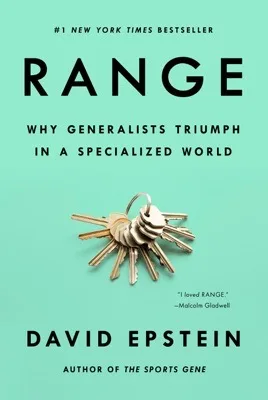
by David Epstein · 2019
MindSpiritEpstein makes the case that outside tidy fields like golf and chess, people who sample widely and start late often win. Six ideas, and the work you drift toward unasked.
What was the most frustrating part of your work or study this week?
From the book · 6 ideas
Epstein has a name for it.
Short summary
Range in brief
Epstein sets Tiger Woods, an early golf specialist, against Roger Federer, who played many sports before settling on tennis, and argues that most top performers look more like Federer. Early, narrow practice pays off in kind fields like golf and chess, where the rules hold and feedback is quick, but much of life is wicked: the rules are unclear and feedback comes late or misleads. There, he argues, breadth wins: sampling widely before choosing, learning that feels slow, connections drawn across distant fields and careers that change course. Seen this way, detours and late starts are often how people find work that fits them.
Epstein builds his case from studies woven through many life stories, and the claim that generalists win is his synthesis of them. He grants that early specialization works in kind fields like golf and chess.
Six ideas, in Epstein’s order
Each idea is named and stated, not worked through. Under each is a question about your own day that no page can answer.
Kind and wicked environments
Borrowing Robin Hogarth’s terms, Epstein separates kind learning environments, such as golf and chess, where patterns repeat and feedback is fast and accurate, from wicked ones, where the rules are unclear or incomplete and feedback is late, inaccurate or both.
Only your day can answer
Which part of your work tells you at once if you got it right, and which part never will?
Desirable difficulties
Epstein argues that learning which feels slow and frustrating, like struggling to come up with an answer before anyone supplies it, or spacing out study sessions, lasts longer than smooth practice. Drawing on learning research, he calls these desirable difficulties.
Only your day can answer
What did you look up today before giving your own memory ten seconds to try?
Match quality
Epstein calls the fit between who you are and what you do match quality. He describes the US Army losing the officers it had spent most on training, after assigning them career paths before they knew much about themselves.
Only your day can answer
Left to yourself on a slow afternoon, which task do you drift toward?
Possible selves
Epstein tells the story of Frances Hesselbein, whose first professional job came at 54 and who went on to run the Girl Scouts. People find out who they might be by trying roles on, he argues, not by planning one self ahead.
Only your day can answer
When this month did you act, even briefly, as a version of yourself you’re curious about?
Withered technology
Epstein profiles Nintendo’s Gunpei Yokoi, who turned his limits as an electronics engineer into an advantage. Yokoi built the cheap, durable Game Boy from withered technology: mature, well-understood parts put to new uses instead of the newest hardware.
Only your day can answer
What new thing are you about to buy or adopt that something you already own could handle?
Dropping familiar tools
Epstein shows experts and organizations clinging to familiar tools after the problem has changed. At NASA before Challenger, he argues, the chain of communication had merged with the chain of command, so engineers’ concerns were diluted on their way up.
Only your day can answer
Where did your usual approach meet a problem it no longer fits, and how long did you keep at it?
The part no summary can do
Epstein can show why breadth and late starts pay off in a wicked world. Where your own work gives honest feedback, and which parts of it fit you, only your week can tell.
In Actium, Range becomes one chapter a day, in the order Epstein wrote it, and each chapter becomes 2–3 small tasks written from your goals and your answers to up to five short questions. Two readers get different tasks, which is why yours aren’t on this page: they don’t exist yet.
Day 1 · when you start
Two quick tasks, starting with a short note
Day 2
Opens tomorrow morning.
Miss a day and your chapter simply waits.

Free to download · 15 days of everything, no card
Some features require a subscription · iPhone only
Read next
More books picked for “Boost intelligence”, and books that train the same stats.
- Thinking, Fast and SlowDaniel KahnemanWhich snap judgment today deserved a second look?
- MindsetCarol S. DweckWhat did you last choose because you knew you’d ace it?
- A Short History of Nearly EverythingBill BrysonWhat changed this week in a view you pass every day?
- Deep WorkCal NewportWhen was your last full hour without a glance at messages?
Get Actium
Start Range in Actium
Pick Range in the app and answer up to five short questions about it and your life. Actium builds your first chapter while you watch, starting with a short note, and every task you finish adds points to Body, Mind, Soul or Spirit.
Free to download · 15 days of everything, no card
Some features require a subscription · iPhone only