How to apply A Short History of Nearly Everything
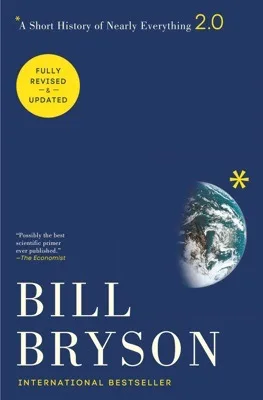
by Bill Bryson · 2003
MindSoulBryson tells science as the story of the people who worked it out, slowly and often against resistance. Six of their stories, each pointing at something slow and unseen near you.
What did you last shrug off without looking into it?
From the book · 6 ideas
Bryson has a name for it.
Short summary
A Short History in brief
Bryson, a travel writer dissatisfied with how little science he knew, set out to learn how scientists came to know what they know, from the size of the universe and the age of the Earth to atoms, cells and early humans. He tells it through the people involved: amateurs and obsessives, bitter rivals, ignored outsiders and lucky accidents. The result is a history of science as a human story, full of wrong turns and long waits for recognition. What it leaves behind is a habit of mind rather than a method: asking how anyone could know a thing, and noticing the slow, unseen forces in an ordinary day.
A popular history drawn from published science and visits to working researchers, not new research. A revised 2025 edition, A Short History of Nearly Everything 2.0, updates it where the science has moved on.
Six ideas, in Bryson’s order
Each idea is named and stated, not worked through. Under each is a question about your own day that no page can answer.
A new point of light
Bryson introduces Robert Evans, an Australian minister who, with a telescope on his back porch, could sweep dozens of galaxies an hour and spot a single new point of light: a supernova, an exploding star that nobody had reported yet.
Only your day can answer
What had changed this week in a view you pass every day, and what gave it away?
Slow forces, vast time
Bryson credits James Hutton, an 18th-century Scottish farmer and geologist, with seeing that land is worn down and built up by slow processes still at work today, which meant the Earth could not be young.
Only your day can answer
Where in your home can you see wear that took years to build up, one touch at a time?
Getting the lead out
Clair Patterson set out to date the Earth by measuring lead, but his samples kept showing far too much, because gasoline had spread lead everywhere. Bryson tells how he built a sterile lab, dated the planet, then fought to get lead out of fuel.
Only your day can answer
What in the air around you today have you stopped noticing because it never goes away?
The Earth moves
Alfred Wegener, a German meteorologist, argued that the continents had once been joined and had since drifted apart. Bryson shows geologists resisting the outsider’s idea for decades, partly because he could not say what moved them, until seafloor discoveries in the 1960s.
Only your day can answer
Whose odd idea did you wave away this week before asking how they got there?
A name for every living thing
Bryson tells how Carl Linnaeus, born in Sweden in 1707, a schoolboy who rarely studied and preferred hunting for plants, brought order to the naming of life with two-part names, the system biologists still use.
Only your day can answer
How many kinds of living thing are within ten steps of you, and how many can you name?
The last dodo
Bryson’s last chapter turns to the dodo, a fearless, flightless bird of Mauritius, first recorded by sailors in 1598 and last reliably seen in 1662. Its passing went almost unnoticed, and its appearance is now known only from old pictures, accounts and bones.
Only your day can answer
What has quietly vanished from your street or routine without anyone remarking on it?
The part no summary can do
Bryson can tell you how Patterson found lead in everything and how Hutton read vast stretches of time in ordinary ground. What your own street and air are quietly showing you this week has not been written down anywhere.
In Actium, A Short History becomes one chapter a day, in the order Bryson wrote it, and each chapter becomes 2–3 small tasks written from your goals and your answers to up to five short questions. Two readers get different tasks, which is why yours aren’t on this page: they don’t exist yet.
Day 1 · when you start
Two quick tasks, starting with a short note
Day 2
Opens tomorrow morning.
Miss a day and your chapter simply waits.

Free to download · 15 days of everything, no card
Some features require a subscription · iPhone only
Read next
More books picked for “Boost intelligence”, and books that train the same stats.
- Thinking, Fast and SlowDaniel KahnemanWhich snap judgment today deserved a second look?
- MindsetCarol S. DweckWhat did you last choose because you knew you’d ace it?
- RangeDavid EpsteinWhich task do you drift toward when nobody’s asking?
- No-Drama DisciplineDaniel J. Siegel and Tina Payne BrysonWhat did your last correction teach besides stopping?
Get Actium
Start A Short History in Actium
Pick A Short History in the app and answer up to five short questions about it and your life. Actium builds your first chapter while you watch, starting with a short note, and every task you finish adds points to Body, Mind, Soul or Spirit.
Free to download · 15 days of everything, no card
Some features require a subscription · iPhone only