How to apply No-Drama Discipline
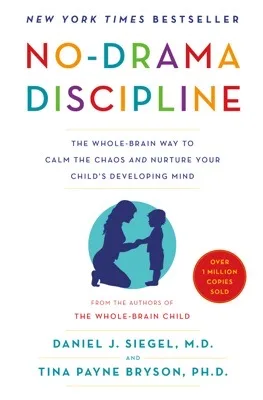
by Daniel J. Siegel and Tina Payne Bryson · 2014
MindSoulTo Siegel and Bryson, the word discipline means teaching, and an upset child can’t learn much until they feel connected. Six ideas, from shark music to a yes with conditions.
In the first minute of your child’s last meltdown, what did you find yourself doing?
From the book · 6 ideas
Siegel and Bryson have a name for it.
Short summary
No-Drama Discipline in brief
Siegel and Bryson argue that discipline was always meant to teach, and that misbehavior usually has a why behind it, a feeling or need worth looking for before reacting to the behavior. Their formula is connect and redirect: first help the child feel understood and calm enough to listen, with the limit still in place, and only then talk about the behavior. What they hope the child takes away is insight into themselves, empathy for others and practice in making things right. What changes is the order of operations in the hard moment, along with the reminder that parents will lose it too and can always reconnect afterward.
Six ideas, in Siegel and Bryson’s order
Each idea is named and stated, not worked through. Under each is a question about your own day that no page can answer.
Discipline means teaching
Siegel and Bryson trace the word to the Latin disciplina, teaching and learning. Discipline has a short-term goal, such as no more toys thrown in a restaurant, and a longer one: self-control and a moral compass that hold when no authority figure is around.
Only your day can answer
Beyond making it stop, what did your last correction today actually teach?
The upstairs brain
Citing research on how the brain changes with repeated experience, Siegel and Bryson argue that the way parents respond to misbehavior helps build a child’s upstairs brain, the part for sound decisions, empathy and morality.
Only your day can answer
Which of your reactions today could your child have predicted, word for word?
From reactive to receptive
Siegel and Bryson put connection before correction because it moves an upset child from reactivity to receptivity, and over time builds the child’s brain and deepens the relationship. Connecting is not permissive, they stress: the limit stays.
Only your day can answer
At which moment in your child’s last meltdown could they actually hear you again?
Shark music
Siegel and Bryson call it shark music: the background noise that past experiences and fears about the future bring into a parent’s reactions. Responding to it, a parent can miss what the child needs right now and what the child is actually communicating.
Only your day can answer
When your child last got under your skin, what future were you picturing for them?
1-2-3 Discipline
Siegel and Bryson boil redirection down to one definition, discipline as teaching; two principles, waiting until the child is ready and staying consistent without turning rigid; and three outcomes: insight into oneself, empathy for others and repair, the ability to make things right.
Only your day can answer
The last time your child lost it, what did they say afterward about why?
R-E-D-I-R-E-C-T
Their redirection tools spell R-E-D-I-R-E-C-T, from reducing words to teaching mindsight tools. One turns a flat no into a yes with conditions: yes, a friend can come over, on Friday when there is time to play, so the child practices handling disappointment.
Only your day can answer
How many of the nos you said today were really a not yet?
The part no summary can do
Siegel and Bryson can tell you that getting below a child’s eye level often cools a heated moment. What plays under your own reactions, and when your child can hear you again, only the next hard moment will tell.
In Actium, No-Drama Discipline becomes one chapter a day, in the order Siegel and Bryson wrote it, and each chapter becomes 2–3 small tasks written from your goals and your answers to up to five short questions. Two readers get different tasks, which is why yours aren’t on this page: they don’t exist yet.
Day 1 · when you start
Two quick tasks, starting with a short note
Day 2
Opens tomorrow morning.
Miss a day and your chapter simply waits.

Free to download · 15 days of everything, no card
Some features require a subscription · iPhone only
About Daniel J. Siegel and Tina Payne Bryson
- Daniel J. Siegelborn 1957
- First published2014
- Also wroteThe Developing Mind (1999), Mindsight (2010), The Whole-Brain Child (2011, with Tina Payne Bryson)
Read next
More books picked for “Be a better parent”, and books that train the same stats.
- The Whole-Brain ChildDaniel J. Siegel and Tina Payne BrysonWhat did you say first when your child last fell apart?
- How to Talk So Kids Will Listen & Listen So Kids Will TalkAdele Faber and Elaine MazlishWhat did you say the third time you asked your kid today?
- Peaceful Parent, Happy KidsLaura MarkhamWhat were you in the middle of when your voice last rose?
- MindsetCarol S. DweckWhat did you last choose because you knew you’d ace it?

Get Actium
Start No-Drama Discipline in Actium
Pick No-Drama Discipline in the app and answer up to five short questions about it and your life. Actium builds your first chapter while you watch, starting with a short note, and every task you finish adds points to Body, Mind, Soul or Spirit.
Free to download · 15 days of everything, no card
Some features require a subscription · iPhone only