How to Talk So Kids Will Listen, put into practice
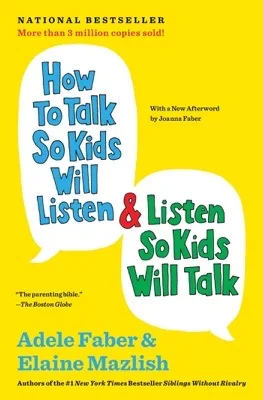
by Adele Faber and Elaine Mazlish · 1980
MindSoulFaber and Mazlish set the things parents say on reflex, from lecturing to labeling, beside words that invite cooperation. Six skills, each ending in your own home.
How did it end the last time your child wouldn’t listen?
From the book · 6 ideas
Faber and Mazlish have a name for it.
Short summary
How to Talk So Kids Will Listen in brief
Faber and Mazlish, two mothers who learned their approach in the psychologist Haim Ginott’s parent groups, argue that children listen to adults who first listen to them. The book sets common reflexes, such as brushing off a child’s feelings, threatening, lecturing, punishing and labeling, beside alternatives, and illustrates some of them with cartoons. Their claim is that the alternatives invite cooperation without threats, voice disapproval without punishment and help children see themselves in a more positive light. What parents get is a small set of skills for the next hard moment, offered, as Faber put it, as the authors’ own story to take what you can from rather than as orders.
Faber and Mazlish wrote from experience, not studies. A 2025 Montreal trial of a parent workshop based on the book found small, lasting drops in children’s acting-out problems, but not in anxious or withdrawn ones.
Six ideas, in Faber and Mazlish’s order
Each idea is named and stated, not worked through. Under each is a question about your own day that no page can answer.
Acknowledging feelings
Faber and Mazlish begin with what happens to children when their feelings are denied or argued away. Their alternatives: listening with full attention, naming the feeling, and granting in fantasy what can’t be had, such as wishing aloud for cereal that has run out.
Only your day can answer
Which of your child’s feelings today did you answer with a reason they shouldn’t feel it?
Engaging cooperation
Faber and Mazlish look at how children react to threats, lectures and yelling, and offer five ways to invite help instead: describing the problem, giving information, saying it in one word, describing your own feelings, or writing a note.
Only your day can answer
What did you hear yourself say the third time you asked for the same thing today?
Alternatives to punishment
The authors question whether punishment is needed at all. In its place they set disapproval voiced without attacking character, clear expectations, a way to make amends, a choice between two options, and solving the problem together with the child.
Only your day can answer
Which problem keeps coming back at home that your child has never been asked to help solve?
Encouraging autonomy
Faber and Mazlish want children to grow self-reliant, which takes room to manage things themselves. The skills here include letting a child decide, respecting the struggle a task can be, asking fewer questions and not rushing to answer theirs.
Only your day can answer
Which job of your child’s did you finish for them this morning because it was faster?
Descriptive praise
The authors separate praise that backfires from praise that describes: what the adult sees, how it makes the adult feel, and a single word that sums it up. Description, they argue, helps children become aware of their own strengths.
Only your day can answer
The last time you told your child good job, what had they actually done?
Freeing children from roles
A child cast as the bully, the whiner or the dawdler can get stuck playing the part, Faber and Mazlish warn. Their ways out include pointing to moments that contradict the label, letting the child overhear praise, and recalling times they acted otherwise.
Only your day can answer
What did your child do this week that doesn’t fit the label your family has for them?
The part no summary can do
Faber and Mazlish can hand you better sentences for hard moments. Which old ones still come out first, and what your child does when a new one lands, you find out at your own kitchen table.
In Actium, How to Talk So Kids Will Listen becomes one chapter a day, in the order Faber and Mazlish wrote it, and each chapter becomes 2–3 small tasks written from your goals and your answers to up to five short questions. Two readers get different tasks, which is why yours aren’t on this page: they don’t exist yet.
Day 1 · when you start
Two quick tasks, starting with a short note
Day 2
Opens tomorrow morning.
Miss a day and your chapter simply waits.

Free to download · 15 days of everything, no card
Some features require a subscription · iPhone only
Read next
More books picked for “Be a better parent”, and books that train the same stats.
- The Whole-Brain ChildDaniel J. Siegel and Tina Payne BrysonWhat did you say first when your child last fell apart?
- Peaceful Parent, Happy KidsLaura MarkhamWhat were you in the middle of when your voice last rose?
- No-Drama DisciplineDaniel J. Siegel and Tina Payne BrysonWhat did your last correction teach besides stopping?
- The Subtle Art of Not Giving a F*ckMark MansonWhat took your attention yesterday that deserved none?



Get Actium
Start How to Talk So Kids Will Listen in Actium
Pick How to Talk So Kids Will Listen in the app and answer up to five short questions about it and your life. Actium builds your first chapter while you watch, starting with a short note, and every task you finish adds points to Body, Mind, Soul or Spirit.
Free to download · 15 days of everything, no card
Some features require a subscription · iPhone only