How to apply Deep Work
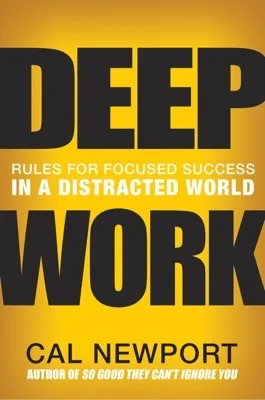
by Cal Newport · 2016
MindSpiritNewport treats hard, undistracted focus as a scarce skill, one that can be trained and protected. His case for depth, and the places where your own focus quietly leaks.
What kept getting in the way of the work that mattered most to you this week?
From the book · 6 ideas
Newport has a name for it.
Short summary
Deep Work in brief
Newport argues that the capacity for long, undistracted attention to hard problems is growing more valuable just as it grows rarer, and that the few who build it will thrive. He makes the case from the economy, from research and from the habits of people who work this way, then asks why so many workplaces, with open offices and constant messaging, push depth out. The second part turns the argument into habits around scheduling, boredom, online tools and the shallow tasks that fill a day. Throughout, he treats focus as a skill to train and protect, not something to summon between emails.
Newport draws on research, on his own habits and on portraits of people who work deeply. His central hypothesis is an argument built from these, not a single tested finding.
Six ideas, in Newport’s order
Each idea is named and stated, not worked through. Under each is a question about your own day that no page can answer.
Attention residue
Newport draws on business professor Sophie Leroy’s research: when you switch tasks, a residue of your attention stays stuck on the first one. Even a quick glance at your inbox, he argues, leaves residue that dampens the work you return to.
Only your day can answer
What were you still half-thinking about the last time you returned to your main task today?
Busyness as a proxy
If depth is so valuable, Newport asks, why do so many workplaces push open offices and constant connectivity? One answer he gives is busyness as a proxy for productivity: visibly doing lots of things stands in for real output.
Only your day can answer
Which task today mostly proved you were busy, without moving anything forward?
Choosing a depth philosophy
Newport argues that deep work needs a way of scheduling it that fits the job. In the bimodal version, used by thinkers from Carl Jung to Adam Grant, whole stretches of time go to depth while the rest of working life carries on.
Only your day can answer
How long is the longest stretch in this week’s calendar that nothing else has claimed?
Embrace boredom
Newport treats focus as a skill that must be developed before it works well, and learning to tolerate boredom is part of that training. He argues it matters more to schedule distraction than to schedule focus, keeping the time between those breaks free of it.
Only your day can answer
What did your hand reach for the last time you stood waiting in a line?
The craftsman approach
Most people, Newport argues, take up a digital tool if it offers any benefit at all. He calls instead for a craftsman approach to tools: keeping only those that bring substantial benefits to the few things a person cares about most.
Only your day can answer
Your most-opened app today: which of your real priorities did it serve?
Fixed-schedule productivity
Newport argues that you get more done if you stop working at 5:30 each day, because a fixed limit pushes you toward better ways of working. He has said the demands of that fixed schedule led him to time blocking and his shutdown ritual.
Only your day can answer
What time did your work actually end yesterday, and what was the last thing you did?
The part no summary can do
Newport can explain why a quick look at your inbox costs more than it seems. Where your own deep hours go, and what keeps taking them, is something you have to catch as it happens.
In Actium, Deep Work becomes one chapter a day, in the order Newport wrote it, and each chapter becomes 2–3 small tasks written from your goals and your answers to up to five short questions. Two readers get different tasks, which is why yours aren’t on this page: they don’t exist yet.
Day 1 · when you start
Two quick tasks, starting with a short note
Day 2
Opens tomorrow morning.
Miss a day and your chapter simply waits.

Free to download · 15 days of everything, no card
Some features require a subscription · iPhone only
About Cal Newport
- Born1982
- First published2016
- Also wroteSo Good They Can’t Ignore You (2012), Digital Minimalism (2019), Slow Productivity (2024)
Read next
More books picked for “Increase productivity”, and books that train the same stats.
- Atomic HabitsJames ClearWhich object in this room decides what you do next?
- Getting Things DoneDavid AllenWhat came to mind last night when you couldn’t act on it?
- The One ThingGary Keller and Jay PapasanWhat decided which task came first this morning?
- The Lean StartupEric RiesWhat did someone actually do with your work this week?
Get Actium
Start Deep Work in Actium
Pick Deep Work in the app and answer up to five short questions about it and your life. Actium builds your first chapter while you watch, starting with a short note, and every task you finish adds points to Body, Mind, Soul or Spirit.
Free to download · 15 days of everything, no card
Some features require a subscription · iPhone only