How to apply Spark
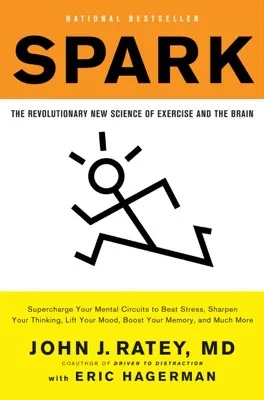
by John J. Ratey and Eric Hagerman · 2008
BodyMindRatey’s claim is that aerobic exercise remodels the brain, readying it to learn and steadying it under stress. What follows is his case, and the hours after your own last walk.
This week, what do you most need a walk or a workout to do for you?
From the book · 6 ideas
Ratey have a name for it.
Short summary
Spark in brief
Ratey, a Harvard psychiatrist, argues that aerobic exercise physically remodels the brain, with effects on stress, mood, memory and attention, not only on the body. He opens with schools in Naperville, Illinois, that rebuilt gym class around fitness rather than sports, then explains how exercise raises BDNF and other chemicals that help brain cells grow, connect and survive. From there he follows the same biology into stress, mood, attention and aging. The practical upshot, in Ratey’s account, is that regular movement that raises the heart rate readies the brain, but the learning, calm or focus it makes possible still has to be put to use.
Ratey builds on lab studies, many in animals, and on results Naperville’s schools measured themselves. He has said no one can yet be sure exercise improves children’s learning, only that the two go together.
This page is not medical advice, and neither is Actium. For a health concern, talk to a doctor.
Six ideas, in Ratey’s order
Each idea is named and stated, not worked through. Under each is a question about your own day that no page can answer.
The new PE
Ratey opens in Naperville, Illinois, where PE teacher Phil Lawler’s new PE traded sports skills for fitness. Students wore heart-rate monitors, and what counted was each one working in their own aerobic zone, not outplaying the class athlete.
Only your day can answer
The last time you moved alongside someone fitter, whose pace were you actually keeping?
Miracle-Gro for the brain
Exercise raises BDNF, a protein Ratey calls Miracle-Gro for the brain because it helps neurons sprout connections and survive. His caveat is that a workout only readies the brain: the learning still has to happen, and it has to be challenging.
Only your day can answer
How many hours passed today between your last brisk walk and your hardest thinking?
Stress that builds
Ratey treats exercise as a manageable dose of stress: strain followed by recovery, he argues, leaves brain cells sturdier and better prepared for the next challenge. He has pointed to rat studies in which aerobically fit animals were less prone to learned helplessness.
Only your day can answer
Which strain this week did you follow with real recovery, and which did you carry straight into the next?
Calming the alarm
Ratey argues that a workout eases anxiety on several fronts at once: it loosens the muscle tension that feeds the feeling, raises calming chemicals such as GABA and serotonin, and engages frontal regions that rein in the amygdala, the brain’s alarm.
Only your day can answer
The last time nerves hit you today, how long did you stay still before you moved?
Switching on attention
Exercise raises dopamine and norepinephrine, chemicals the attention system runs on, and Ratey argues it switches on executive functions such as working memory and impulse control. For children, he says, the practical result is less impulsiveness and more readiness to learn.
Only your day can answer
When did your focus run cleanest yesterday, and what had your body been doing just before?
Movement that asks for skill
Ratey’s regimen rests on aerobic work that raises the heart rate, but he argues the brain gains more when movement also demands skill and involves other people, as dance, martial arts, climbing and team games do.
Only your day can answer
How much of your last walk or workout could you have done half asleep?
The part no summary can do
Ratey lays out what a brisk walk does to BDNF and to the brain’s alarm system. Which kind of movement steadies you, and when your thinking runs sharpest after it, no lab result can tell you.
In Actium, Spark becomes one chapter a day, in the order Ratey wrote it, and each chapter becomes 2–3 small tasks written from your goals and your answers to up to five short questions. Two readers get different tasks, which is why yours aren’t on this page: they don’t exist yet.
Day 1 · when you start
Two quick tasks, starting with a short note
Day 2
Opens tomorrow morning.
Miss a day and your chapter simply waits.

Free to download · 15 days of everything, no card
Some features require a subscription · iPhone only
Read next
More books picked for “Improve physical health and energy”, and books that train the same stats.
- Can’t Hurt MeDavid GogginsWhere did you stop today with more still left in you?
- Atomic HabitsJames ClearWhich object in this room decides what you do next?
- The Body Keeps the ScoreBessel van der KolkWhat made you tense up today before you knew why?
- Why We SleepMatthew WalkerAfter your shortest night, what small thing set you off?

Get Actium
Start Spark in Actium
Pick Spark in the app and answer up to five short questions about it and your life. Actium builds your first chapter while you watch, starting with a short note, and every task you finish adds points to Body, Mind, Soul or Spirit.
Free to download · 15 days of everything, no card
Some features require a subscription · iPhone only