How to apply Breath
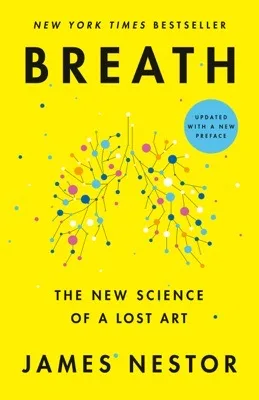
by James Nestor · 2020
BodySoulMost of us breathe badly, in Nestor’s view: through the mouth, too fast and too much. His case starts with ten days of his own nose plugged.
Which side of your own breathing have you paid the least attention to this week?
From the book · 6 ideas
Nestor has a name for it.
Short summary
Breath in brief
Nestor argues that modern humans have become poor breathers: softer diets have narrowed our mouths and airways, and many of us breathe through the mouth, too fast and too much. He builds the case from his own body, from researchers and dentists, and from old practices such as pranayama, Sudarshan Kriya and Tummo. Most of the book argues for breathing through the nose, slowly and a little less, with full exhales and food that needs chewing. Its practical point is that breathing runs on its own but can also be steered, and that small changes in how you inhale and exhale may change how you feel.
Reviewers, among them the psychiatrist Kate Womersley in The Spectator and Sam Kean in The Wall Street Journal, found that Nestor leans on anecdote and that some of his health claims outrun the evidence.
This page is not medical advice, and neither is Actium. For a health concern, talk to a doctor.
Six ideas, in Nestor’s order
Each idea is named and stated, not worked through. Under each is a question about your own day that no page can answer.
Mouthbreathing
Nestor’s case against mouthbreathing starts with himself: for a Stanford study, he spent ten days with his nose plugged. He reports that his snoring rose by 4,820 percent, his blood pressure climbed and he averaged 25 sleep apnea events a night.
Only your day can answer
At which moments today did you catch your mouth hanging open?
The nasal cycle
The nose filters and warms the air, and its spongy tissue swells and shrinks so that the nostrils take turns. Nestor describes this nasal cycle, first recorded in 1895, and the link some researchers see between each side and a calmer or more alert body.
Only your day can answer
Which nostril is carrying most of your air right now, and when does it switch?
Slow breathing
Italian researchers found that reciting the rosary or a yoga mantra slowed people’s breathing to about six breaths a minute and brought their heart rhythms into step. Nestor uses such findings to argue for breaths of about 5.5 seconds in and 5.5 seconds out.
Only your day can answer
How many breaths fit into one minute of your ordinary afternoon?
Breathing less
Nestor argues that many of us habitually take in more air than the body needs. He follows Konstantin Buteyko, a Soviet doctor who trained patients to breathe less, and the runners and swimmers who trained by breathing less on purpose.
Only your day can answer
How far does your chest rise with each breath while you sit reading this?
Soft food, small mouths
Nestor traces crooked teeth and cramped airways to soft, processed food. Skulls from before the industrial age, he reports, had wider palates than ours, and he argues that jaws and airways grow with the work of chewing.
Only your day can answer
Which meal today gave your jaw any real work to do?
More, on occasion
Breathing, Nestor writes, gives us a way to consciously reach the autonomic nervous system that runs the body unbidden. Short bursts of heavy breathing, as in Tibetan Tummo or Wim Hof’s method, switch on the stress response on purpose.
Only your day can answer
What made your breathing speed up today, and how long until you noticed?
The part no summary can do
Nestor can tell you what ten days of mouthbreathing did to his sleep. How you breathe at your desk, over lunch or in a tense moment is not in any of his chapters.
In Actium, Breath becomes one chapter a day, in the order Nestor wrote it, and each chapter becomes 2–3 small tasks written from your goals and your answers to up to five short questions. Two readers get different tasks, which is why yours aren’t on this page: they don’t exist yet.
Day 1 · when you start
Two quick tasks, starting with a short note
Day 2
Opens tomorrow morning.
Miss a day and your chapter simply waits.

Free to download · 15 days of everything, no card
Some features require a subscription · iPhone only
Read next
More books picked for “Reduce stress and increase inner stability”, and books that train the same stats.
- The Power of NowEckhart TolleWhich small thing today got a reaction older than itself?
- 10% HappierDan HarrisWhich push from your inner voice today backfired?
- Why We SleepMatthew WalkerAfter your shortest night, what small thing set you off?
- Can’t Hurt MeDavid GogginsWhere did you stop today with more still left in you?

Get Actium
Start Breath in Actium
Pick Breath in the app and answer up to five short questions about it and your life. Actium builds your first chapter while you watch, starting with a short note, and every task you finish adds points to Body, Mind, Soul or Spirit.
Free to download · 15 days of everything, no card
Some features require a subscription · iPhone only